
By Michael Angel Martin
The Catholic Case Against War: A Brief Guide, written by David Carroll Cochran (Notre Dame, IN: University of Notre Dame Press, March 2024), 194 pp., ISBN: ISBN 9780268207892.
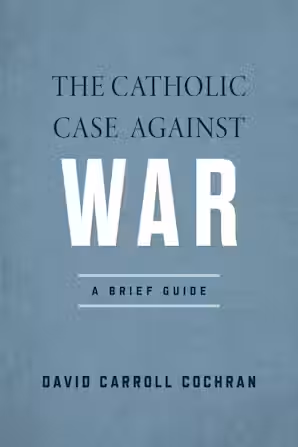
When I first received my copy of David Cochran’s The Catholic Case Against War: A Brief Guide, I felt my usual unease whenever the words “the Catholic case” appeared anywhere. What does it mean to make a Catholic case? The question of authority and Catholic identity is never as tidy as apologists claim—not after the Second Vatican Council, and distinctly not under Pope Francis’s synodal direction. Most Catholics in the peace and justice movement have long held the authoritative, magisterial nature of the hierarchical church in tension with a reform-hearted tradition that recognizes a kaleidoscopic reality in which all the baptized live out a priestly call.
Early in this serviceable book’s introduction, we learn what Cochran means by a Catholic case against war—he means the popes! True, Cochran qualifies his choice, stating “that while thinkers, activists, and national bishops conferences have made significant contributions to developing Catholic teaching” about war, in the interest of concision, he decides “to only use formal Vatican documents and papal statements.” Despite my misgivings about appealing to papal authority alone, I am grateful Cochran has done so. As someone new to Catholic peacework, I am struck by how sharply the popes, largely in the 20th century, see the full antiwar vision.
At first, Cochran unfolds the development of Christianity’s antiwar persuasion. While early Christians typically refused participation in war, the church eventually developed a just war tradition, arguing that war “is sometimes necessary to protect a just and peaceful order given the realities of sin in the world.” Over time, the Vatican applied stricter parameters around what comprised a just war. Then, in the 20th century, the popes began to issue statements of varying authority doubting the possibility of a just war altogether, specifically as modern warfare tested its theoretical limits. In each chapter after that, Cochran expounds on overarching themes from critiques of war regarding death, destruction, and dehumanization, to alternatives like nonviolence, prevention, global governance, economic and political justice, and finally, abolition.
Cochran extensively quotes papal documents denouncing the harrowing realities and false promises of war, as well as Vatican advocacy for nonviolent alternatives — including, to my astonishment, abolition. Now, I know Pope Francis has cried “Never again war!” on several occasions; but I did not know those cries echoed his predecessors back to Paul VI. And it’s not just rhetoric. Cochran unspools the theological threads and doctrinal contexts sustaining papal calls for abolition. The popes—chiefly Benedict XVI, John Paul II, and Francis— have each called us to hope for the abolition of war without denying the reality of the sins that wage it.
In other words, the church’s recent antiwar teachings are anything but only so much moral sentimentality, worthy of waving away. Yet, in a sense, The Catholic Case Against War is less a book about the Catholic case against war as much as a slim compendium of growing empirical research that confirms nearly every antiwar and nonviolent conviction undergirding Christian peacebuilding, including the full extent of war’s destruction, the power of nonviolent practices and global cooperation, the need for pairing peace with justice, and the historical evidence for anticipating a war-free future.
While presented in the tone and structure of a college textbook, The Catholic Case Against War rages against charges of sentimentality, naivety, and false utopianism that our broader culture lodges so reflexively at antiwar convictions, particularly abolition. Cochran’s brief guide is a stark look at the horrendous absurdity of war and a pragmatic offering of solutions that could render war a relic of a wicked past. In the shadow of Ukraine and Gaza, however, it would be uncharitable not to empathize with the sometimes doubtful; I don’t mean the warmongers, of course, but the rest of us who, following the unrelenting horrors day by day, hope against hope for abolition.

Michael Angel Martin, state coordinator for Pax Christi Florida and member of the Pax Christi USA Young Adult Caucus, works in higher education and lives with his family in Miami, Florida. On occasion, he writes poems and book reviews.
Thank you for this overview. It has provided invaluable perspective for me personally. So much of what we encounter are polarizing rants and diatribes representing points that themselves are legitimate and well-founded.
Appreciation is due to Michael Angel Martin for bringing to our attention, via his review of The Catholic Case Against War by David Cochran, the consistent opposition to war and militarism be our contemporary popes, not just Francis. I hope this study will be an important addition to anti-war literature such as perhaps the most powerful anti-war novel ever written, All Quiet on the Western Front (1928) by Erich Maria Remarque and the contemporary masterpiece, A People’s History of the United States (1980) by the renowned historian Howard Zinn, an ex-bomber during WWII and an American Jew who stated to the journalist Amy Goodman shortly before his death in 2010 that not even WW II was justified and could have been avoided, thus sparing the lives of millions.
David-Ross Gerling, PhD
History reveals much of the willingness of Popes to support war. “God Wills It” was the rally call of Pope Urban II as he urged Christians to go
to the Holy Land and slaughter the infidels.
What did the RC Catholic Pope Pius XII do to prevent the worst war in
history from happening? His silence as the NAZIS rolled over Europe and his knowledge of the Holocaust led him to silence. Silence made him complicit in the horrors.
Pope Francis must speak out often and in the strongest terms now as Israel commits unspeakable atrocities in Gaza.
His Vatican diplomatic team will not approve but he must speak as Christ
would speak.