


The Pax Christi USA Indigenous Solidarity Working Group has compiled the following Prayer-Study-Action resource in anticipation of the World Day of Prayer for Care of Creation on September 1 and Catholic Nonviolence Days of Action (September 21-October 2).
The theme for this year’s Season of Creation is Living Water.
This year’s theme for the Vatican’s World Day of Prayer for Creation is, “They shall beat their swords into plowshares and their spears into pruning hooks” (Isaiah 2:4).


We acknowledge that the Catholic Church’s Doctrine of Discovery – a doctrine that established the legal and religious standing of Europeans who “discovered” new lands to seize such lands from its inhabitants – is at the root of the harm and violence done to indigenous communities in the name of Christ. The harm was done in the name of Christ; we have to undo it in the name of Christ.
Below is more information about the upcoming Literary Circle for Liberation on The Land is Not Empty: Following Jesus in Dismantling the Doctrine of Discovery by Sarah Augustine in September and October. In November, we will invite members to a panel of Native activists who will speak on the topic of reparations.
We also encourage members to commemorate “Orange Shirt Day” on September 30 to create awareness of the individual, family, and community intergenerational impacts of the Native residential schools.
PRAYER
As we acknowledge and affirm that we belong to the land, the land does not belong to us, we invite you to incorporate the following refrain into your everyday life: “Water is life. The land is not empty.” This refrain takes its inspiration from the indigenous water movement and the title of the study circle book.


As we awake in the morning and our feet touch the ground, we whisper: “Water is life. The land is not empty.”
As we prepare our food and sit to eat, individually or in community, we pray, “Water is life. The land is not empty.”
As we walk outside …“Water is life. The land is not empty.”
As we hear of fires, earthquakes, and flooding caused by climate change …“Water is life. The land is not empty.”
As we support indigenous-led efforts to name the preventable violence … “Water is life. The land is not empty.”
As we hold the earth in our hearts and touch the soil with our hands, committing to resist the use of pesticides …“Water is life. The land is not empty.”
As we work to resist the development, storage, and testing of nuclear arms on indigenous land … “Water is life. The land is not empty.”
As we look up to the stars and admire the Creator’s cosmos … “Water is life. The land is not empty.”
As we reflect in this land that is not empty, we softly walk across the Earth and revere the land we stand on, the sky we sit beneath, the air that encircles us, and the water that sustains us.
Additional prayer resources from the Catholic Climate Covenant, USCCB, CAFOD, and more:


- What is the Season of Creation? Informational flier to accompany the Season of Creation liturgical banner.
- US Conference of Catholic Bishops’ Season of Creation bulletin insert and a reflection issued for 2023 Season of Creation by USCCB can be found here.
- 2026 Feast of St. Francis Program, All Creation Sings: Celebrate the Jubilee Year of Saint Francis and the Season of Creation with the 2026 Feast of St. Francis program from the Catholic Climate Covenant. This year’s Feast of St. Francis program, All of Creation Sings, will guide participants through 90-minutes of prayer, reflection, discussion, and suggested actions.
- Feast of St. Francis Eco-Spirituality Resource, Spreading Seeds of Peace and Hope for Creation” A timeless collection of prayers, poems, art, videos, reflections, liturgies, and programs.
- The World Day of Prayer for Creation: September 1 (or the following weekend) is the perfect time to schedule a Care for Creation Mass. Pope Leo XIV enabled our liturgical celebrations of this observance by promulgating the new Mass for the Care of Creation, recently added to the Missal. More information on the World Day of Prayer for Creation can be found in this new World Day of Prayer for Creation website. Here you will find resources for the Mass (liturgical texts and pastoral resources), formation resources, Pope Francis’ and Pope Leo’s messages for September 1, and more.
- The United States translations of the Mass for the Care of Creation liturgical texts are now available: Go here to learn more and download the liturgical texts in English and Spanish.
- September 1 special edition of Homily Helps, written by Fr. Jim Puglisi SA Ph.D. His presentation of the resource is also part of the global webinar lifting the new Mass for the Care of Creation (starts at 44:17)
- Watch the global Catholic webinar webinar about the liturgical celebrations of the World Day of Prayer for Creation with the new Mass that was added to the Missal here.
- Three flyers promoting the Mass for Care of Creation are now available: here, here, and here
- Choral and Mass Pieces for the Season of Creation by Elizabeth Cerceo
- World Day of Prayer (Sept. 1) resources from CAFOD (Catholic Agency for Overseas Development, part of the Catholic Church of England and Wales)
- More Mass for Creation resources may be found here.
STUDY
Reflection on reciprocity

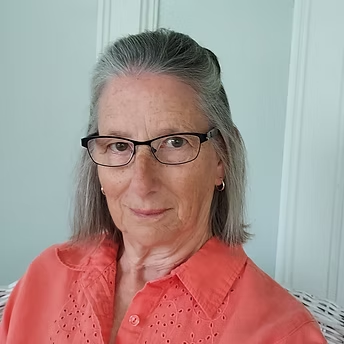
Written by Mary Beth DiMarco
Pax Christi USA Indigenous Solidarity Working Group
Pax Christi Maine
Each year from September 1 to October 4, the Christian family unites for the Season of Creation, a worldwide celebration of prayer and action to protect our common home. As followers of Christ from around the globe, we acknowledge that our well-being is interwoven with the well-being of the Earth.
The theme this year is “Living Water” and the primary text is Ezekiel 47:9 and 12, prophetic writing from the Babylonian exile that is full of symbolism, longing, and hope.
Reconciliation with God results not only in restored worship but in renewed land, healed ecosystems, and abundant life. Ethical implications follow naturally: if God’s presence manifests itself as life-giving water, authentic worship cannot be confined only within ritual observance. Faithfulness must be measured by its impact on all conditions that sustain life. Care for creation thus emerges as a direct consequence of a restored relationship with God.
Our brothers and sisters indigenous to Turtle Island and other lands have a deep and practical understanding of the concept of reciprocity with the rest of creation. These ancient communities, who know life in terms of place rather than time, hold knowledge built over thousands of years of being cared for by and caring for their land and waters. They have much to teach about renewed land, healed ecosystems, and abundant life. Following colonization and continuing with today’s economy of extraction – even in the name of “green” energy – they also suffer the most from abuse and destruction of land and waters. It is time for us to listen.
Reciprocity is not a transactional arrangement of paying for what we take or use, but a web of relationships that acknowledges our interdependence and continues the flow of life. What can we give back to the river for the fish we catch? We can first ask to make sure the river can afford the taking, then take only what we need, and then use all of our powers to assure that the river and the fish will be there and be healthy for future generations.
In her book, The Land is Not Empty: Following Jesus in Dismantling the Doctrine of Discovery, Sarah Augustine writes that, “The nature of God, God’s eternal nature and divine power, is clear. Our instructions are clear. We must choose the systems of Life over the systems of Death: Defend the oppressed.” Reciprocity is how we participate in the nature of God, how we choose to participate in the systems of Life.
We can practice reciprocity by:
- Recognizing what Robin Wall Kimmerer calls “enoughness,” “a radical act in an economy that is always encouraging us to consume more.”
- Refraining from and denouncing harmful pollution, while at the same time urging governments, local authorities, industry, and agriculture to act responsibly and protect water sources.
- Moving from domination to humility, from exploitation to care, and from short-term profit to long-term flourishing.
- Restoring land in our churches, homes, and communities.
Let us overcome our fear and step into the water of God’s love – to be part of the River of Transformation for the world, to see the literal healing and renewal of creation and the blessing of the Earth.
- Sarah Augustine, The Land is Not Empty, Herald Press, Harrisonburg, VA, 2021
- Robin Wall Kimmerer, The Serviceberry, Scribner, New York, 2024
ACTION
Join the four-part Literary Circle for Liberation study circle hosted by the Pax Christi USA Indigenous Solidarity working group and Pax Christi Anti-Racism Team (PCART) on September 15, September 30, October 13, and October 27.


All are welcome to participate in this vital, transformative community book discussion on “The Land is Not Empty: Following Jesus in Dismantling the Doctrine of Discovery” by Sarah Augustine. Rooted in Pax Christi’s traditional model of “Pray-Study-Act,” this series offers an opportunity to examine the ongoing harms of the Doctrine of Discovery—the 15th-century legal and theological framework that gave Christian governments a perceived moral right to seize lands populated by Indigenous peoples.
Author Sarah Augustine, a Pueblo woman and justice advocate, challenges us to look past purely symbolic gestures to discover the scriptural “Jesus Way” of active solidarity, ecological restoration, and genuine systemic repair.
Whether you are seeking to deepen your commitment to anti-racism, explore history through a peace-building lens, or learn how our working group can actively collaborate on structural healing, your perspective and presence are deeply valued.
Dates:
Tuesday, September 15
Wednesday, September 30
Tuesday, October 13
Tuesday, October 27 (Author Sarah Augustine will join for the final session.)
Time: 7 PM Eastern/4 PM Pacific
IMPORTANT NOTE: Participants are responsible for securing their own copy of the book before our first gathering. “The Land is Not Empty” can be purchased or downloaded through major retailers and digital ebook platforms.
Additional actions
- Take part in September 30 National Day of Truth and Reconciliation’s Orange Shirt Day
- Research and get involved with the Landback movement, including Land Justice Futures for religious communities: Resources on Indigenous Land Back Projects
- Stay tuned for more information about the Catholic Nonviolence Days of Action – September 21-October 1
- Save the date: The Pax Christi USA Indigenous Solidarity Working Group will host an online event on Tuesday, November 10 on reparations – more information coming soon!