


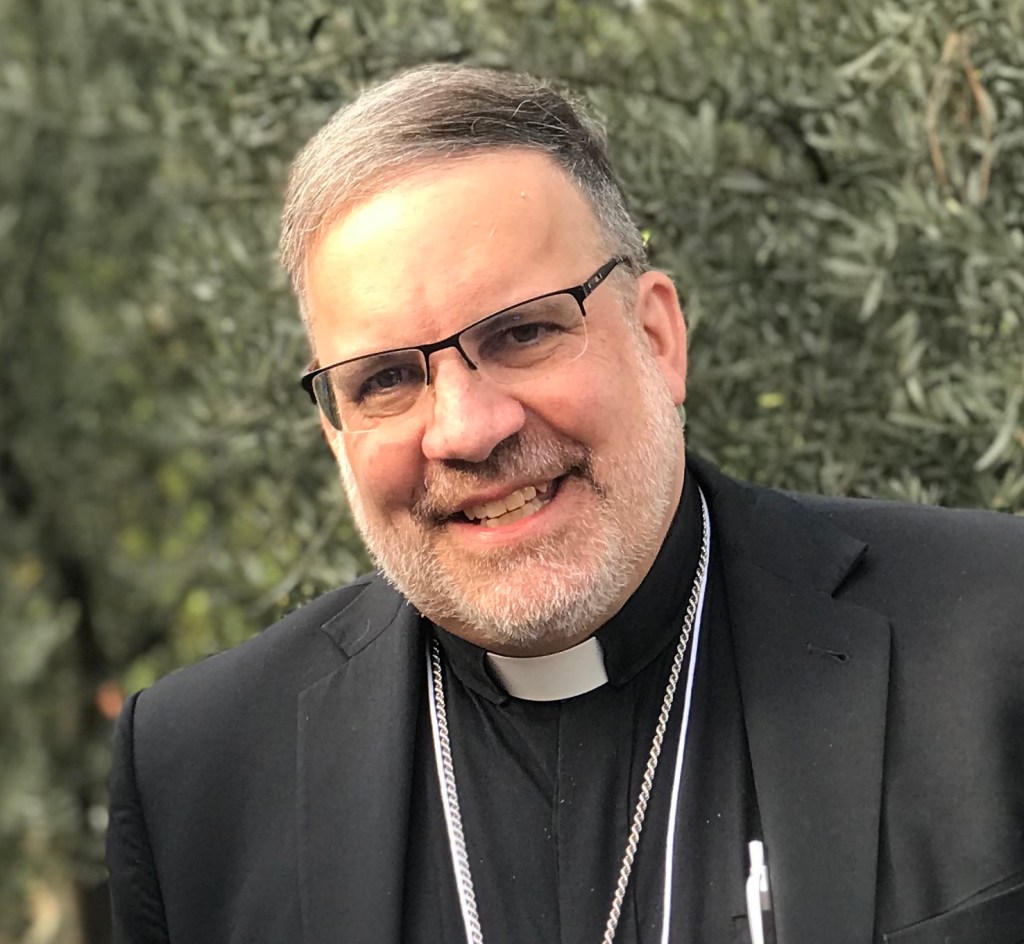
By Bishop John Stowe, OFM Conv.
Diocese of Lexington, KY
Bishop President, Pax Christi USA

At our recent Pax Christi USA National Council meeting in Washington, D.C., held Nov. 1-3, we began our time together practicing the “Conversations in the Spirit” which have become the methodology of the Synod on Synodality. This method is being taught throughout the Church as a way to do “ecclesial discernment” so that our decision-making will be inclusive and involve the Holy Spirit. It was the final weekend of the seemingly endless presidential campaign when we met, and naturally we were all concerned and prayerful about the impending outcome. We reflected on being a people of hope, St. Paul’s admonition to rejoice in all circumstances, and we shared our thoughtful and prayerful responses to the possible election results. Each shared their thoughts on how the election of each candidate might affect them personally and how Pax Christi USA would be changed by either a Harris or a Trump election.
Following the prescribed method, we listened for what the Holy Spirit might be saying to us at this moment, even before we knew the outcome. We clearly affirmed that our work of peace-building is essential, perhaps more than ever in our polarized context which the election might exacerbate. We were affirmed in the importance we place on creating and sustaining relationships. We recognized the intersectionality of so many of the threats to peace today: nuclear armament, climate change, massive human migration, threats to democracy, “Christian” nationalism, materialism, increases in mental health challenges, etc.
Not surprisingly, our answers to the questions differed; from someone who said they would rejoice regardless of the outcome to many who were fearful of the outcome which actually occurred. Several thought that even if we had avoided a Trump presidency, there would have been so much work to do because of the presumption that the U.S. is defined by its military strength on the world stage and because the poor treatment of migrants, from indifference to cruelty, has continued regardless of which political party is in office. The unleashing of “Christian” nationalism is unlikely to dissipate in the near future.
But the response, in the form of another question, that remained with me after the session was, “How much risk are we willing to take as a movement?” To continue working for the dismantling of the white-supremacism systematically embedded in our nation just became more difficult. To stand with immigrants and refugees, recognizing that we are all sojourners with no lasting home, will be more costly in many ways. To uphold the dignity of women, made in the image and likeness of God with full and equal dignity and rights just became unpopular. Even to simply listen to each other becomes counter-cultural.
Will the effect of a multiply-convicted felon provide any impetus for the necessary work of criminal justice reform? Not if some people never face a penalty while others are left without voice or vote for years for lesser offenses.
Will the election of a jury-determined rapist cause women to think that their own defense just got much tougher in every sense? I am afraid so.
Will the re-election of someone famous for stiffing workers, leaving bills unpaid and denigration of unions affect the rights of workers and the ability to advocate for just and fair wages and treatment? It seems so.
Will the election of someone who stubbornly believes in his own faulty understanding of how tariffs work really help the economy? Can’t see how.
Will someone who ignored, then mishandled, a global pandemic and put the lives of millions of US Americans at risk, really be capable of his constitutional duty to protect us? He has demonstrated that he can’t.
Will someone who enjoys the company of brutal autocrats uphold the founding ideas of US American democracy? Not likely, at least not without our constant and loud protest.
What faces us as Pax Christians is the question of how hard are we willing to work for peace and justice, to end systemic racism, to conserve the planet and to redirect resources from weapons to the common good?
It comes back to that question, how much are we willing to risk in hope.