


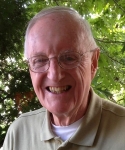
by Joseph Nangle, OFM
Pax Christi USA 2023 Teacher of Peace
This week’s “Hope and Challenge” page reflects the formal definition “essay”: an attempt, an effort. It approaches a topic and growing phenomenon which for most of us is astounding, mystifying, and to be honest frightening: Artificial Intelligence. It would seem presumptuous for the average person to attempt a significant judgment on the subject. However, as religious people alive at this era of human history, we must take Artificial Intelligence seriously.
We are already experiencing the once-unimaginable possibilities of Artificial Intelligence. Take for example the now familiar yet astounding tool of the Global Positioning System (GPS). Yet while the predictions for Artificial Intelligence are mind-bending, some of them go far beyond what it means to be thinking, feeling and reacting creatures “made in the image and likeness of God.”


A recent book by a computer scientist and famed “transhumanist”* underscores the need for calm and lucid thinking on this subject. Ray Kurzweil, who is called the “Oracle of Silicon Valley,” sees a future in which machines take over, perhaps even to the point of achieving a transcendent experience along the way. In his book entitled “The singularity is nearer: When we merge with AI,” Kurzweil makes some astounding claims/fantasies which defy rationality: Machines will outperform their human makers; “the struggle for human survival will fade into history”; death will somehow be remedied; and humans will be relieved from the burdens of physicality.
Becca Rothfeld’s review of “Singularity is Nearer” in the June 30 Sunday Washington Post Book section raises common-sense objections to these claims. The reviewer writes that the capacities of Artificial Intelligence can easily fall into the hands of bioterrorists; the accomplishments of Artificial Intelligence have already made life unbearable for many (for example “even now teenage girls are being swept up in a stream of diabolically addictive images”); misinformation is spreading like wildfire, Neo-nazis are radicalized on YouTube.
The review concludes with the all-important observation that in direct contrast to the beliefs of the Kurzweils of the world, the fact that we CAN use these ever-more sophisticated technologies it never follows that we SHOULD.
Other considerations spring to mind as cautions or limits to what might be called the new idol of Artificial Intelligence. Its capabilities cannot include self-reference, the amazing human capacity to reflect on oneself, or changing course, asking for pardon. Nor do they produce deeply human qualities such as self-giving love, mourning losses, experiencing religious sentiments, engaging in contemplative prayer, or the gift of ones very self – even dying – for a common good.
Compare the claims of Artificial Intelligence with what Catholic Social Teaching holds as the ideals that must inspire the human enterprise: “Transition from less human conditions to truly human ones: the rise from poverty to the acquisition of life’s necessities; the elimination of social ills; broadening the horizons of knowledge; acquiring refinement and culture… acquiring a growing sense of other people’s dignity; a taste for the spirit of poverty; an active interest in the common good and a desire for peace; acknowledgement of the highest values, and God Himself, their author and end…” (Blessed Pope Paul VI “On the Development of Peoples,” #21)
Predictably, in recent years our very modern Pope Francis has weighed in consistently on Artificial Intelligence. He has not done so, however, from some abstract, theoretical position, rather one based on the conviction that science and theology are not only able to dialogue, but must. Relying heavily on consultants from the Vatican’s Academy for Life, in particular, Franciscan Paolo Benanti, a member of the United Nations’ Advisory Body on Artificial Intelligence, the pope most recently added his voice to calls for an international treaty to regulate Artificial Intelligence.
Simply stated Francis’ message to the scientists and the world is: DO NOT LOSE YOUR HUMANITY.
*Transhumanists are those who propose that humans will evolve into an enhanced species that transcends their/our humanity.
Joe Nangle OFM is a Pax Christi USA Ambassador of Peace and the 2023 Pax Christi USA Teacher of Peace. As a member of the Assisi Community in Washington, D.C., he is dedicated to simple living and social change. Joe also serves as the Pastoral Associate for the Latino community at Our Lady Queen of Peace, Arlington, Virginia.